Building AI-Ready Data Foundations in Snowflake: The Missing Layer in Most Enterprises
Jagadishwar Pannala
1. Executive Summary
Enterprises have modern Snowflake platforms and even Cortex access but still fail to scale AI.
The root cause is not the AI layer. It is the absence of a structured, AI-ready data foundation between raw data and AI execution.
This blog introduces a Medallion + Semantic + Feature + Context architecture pattern that enables consistent, governed, and context-rich AI consumption and covers exactly what breaks in production and how to fix it.
What "AI-Ready" Actually Means:
- Data is idempotent and replayable
- Features are point-in-time correct and reusable
- Pipelines handle schema evolution safely
- Data is governed: PII, RBAC, masking
- Latency and cost are predictable and monitored
- Feedback loops are operational not just planned
2. Background & The Real Problem
Most enterprises are BI-ready, not AI-ready. Snowflake Cortex provides AI execution but assumes input data is already clean, contextual, structured, and governed.
In practice, it rarely is.
Cortex amplifies the quality of your data it does not fix it.
Cortex does not solve data quality issues, feature consistency, context enrichment, or cost control.
The enterprises that fail at AI do not fail because of the AI layer. They fail because of the data layer beneath it.
What We've Seen Break in Production
| Failure | Root Cause | Resolution |
|---|---|---|
| Cortex outputs became inconsistent overnight | Two teams calculated "denial rate" differently in Gold layer | Single semantic definition enforced via dbt metric layer; duplicate logic deprecated |
| Feature backfill corrupted live predictions | Backfill overwrote point-in-time features without time-travel guard | Versioned feature snapshots + backfill isolation flag; backfills run to staging before promotion |
| MERGE degraded from 4 min → 47 min | Table exceeded 500M rows with no clustering key | Cluster key added on join columns; monthly recluster; 2x duration alert set |
| Redis served stale features for 6 hours | TTL too high; no invalidation trigger on upstream update | TTL reduced to 90s; Snowflake Task → webhook → Redis flush on critical updates |
| Snowpipe silently dropped records | New upstream column added without contract validation | Schema validation at Bronze ingestion; quarantine routing; contract CI/CD checks added |
| Cortex costs spiked 8x at month-end | Full unfiltered claim notes passed as prompt input | Inputs pre-aggregated; notes truncated to 500 tokens; output caching implemented |
These are not edge cases. They are the default outcome when AI is treated as an add-on rather than an architecture concern.
3. Problem: Symptoms & Impact
Symptoms: AI outputs inconsistent despite using Cortex ad-hoc feature engineering outside Snowflake no standardized business logic data lacks context teams duplicating pipelines.
Impact: AI initiatives fail to move beyond pilots time-to-production grows from weeks to months costs rise from duplication compliance risks from ungoverned AI access silent model degradation from absent feedback loops.
4. Requirements & Assumptions
| Dimension | Detail |
|---|---|
| Data Volume | 100M–10B rows/month |
| Latency | Batch (hours) → Micro-batch (5–15 min) → Real-time (<100ms via separate serving layer) |
| Environments | Dev / UAT / Prod |
| Data Sensitivity | PII / PHI — RBAC + SSO + row/column-level security |
| Tools | Airflow, dbt, Fivetran, Snowpipe, Streams & Tasks, Dynamic Tables |
| Key Constraints | Schema drift, multi-source ingestion, latency vs cost trade-offs, Cortex regional availability |
Critical: Snowflake is not a sub-50ms serving layer. True real-time decisioning requires a dedicated online serving architecture.
Cortex is also not available in all Snowflake regions or editions — validate before architecture commitment.
Data Contracts & Schema Evolution:
| Area | Approach |
|---|---|
| Data Contracts | Versioned producer–consumer contracts for critical datasets |
| Schema Validation | Violations route to quarantine — not pipeline failure |
| Breaking Changes | Quarantine + alert + consumer notification |
| Dataset Versioning | Consumers pin to version until explicitly migrated |
5. Recommended Architecture
5.1 High-Level Flow
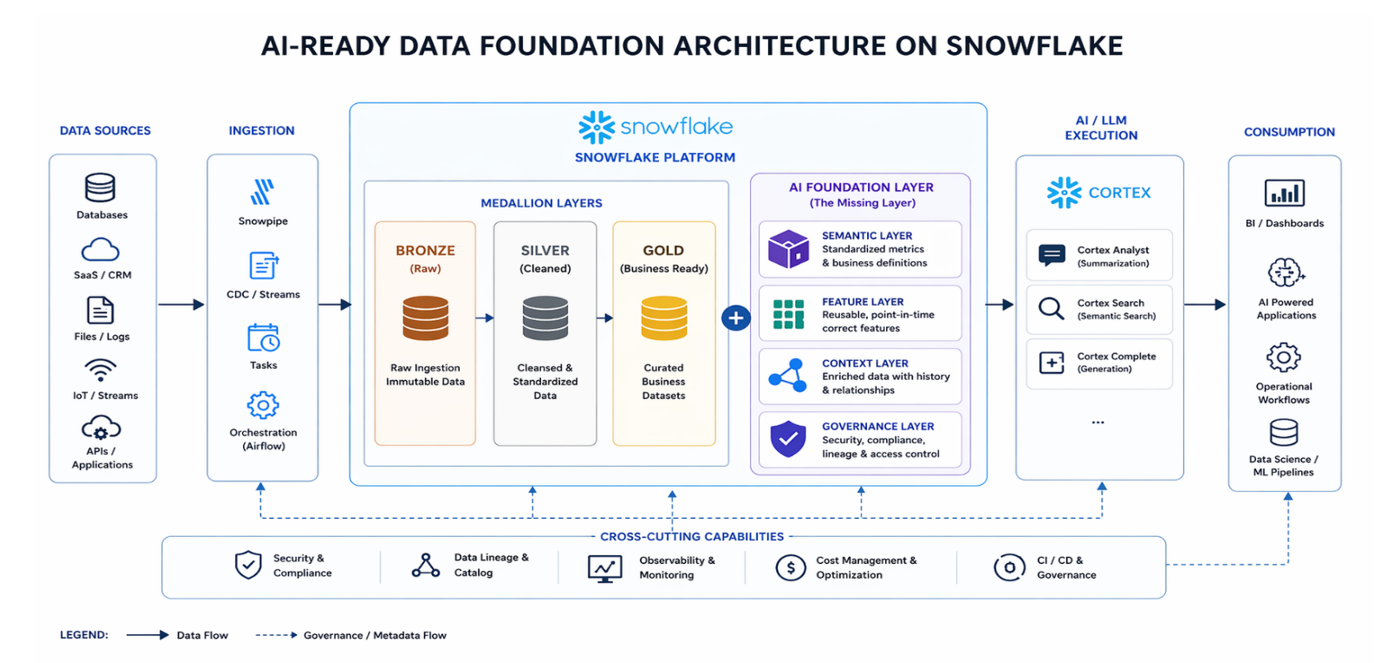
Source Systems -- Ingestion -- Bronze -- Silver -- Gold -- AI Foundation Layer -- Cortex -- Consumption -- Feedback Loop
The AI Foundation Layer is what separates a BI platform from an AI platform.
It sits between the Gold layer and Cortex and comprises four components:
- Semantic Layer: Standardizes business definitions and metrics. Without it, the same metric calculated differently by two teams produces inconsistent Cortex outputs — the most common failure mode we observe.
- Feature Layer: Point-in-time correct, versioned feature tables ensuring consistency between training and inference. Must be designed correctly from day one retrofitting at 1B+ rows requires full historical recompute.
Feature Consistency Model: Ensures alignment between offline (training) and online (serving) by enforcing identical transformation logic, feature definitions, and time semantics.
Guarantees: Maintains consistency by embedding feature version IDs in both training datasets and inference requests, with regular monitoring of training-serving skew.
Pattern: Follows a structured flow: feature definitions are versioned, materialized, synchronized, and served to ensure reliability and reproducibility. - Context Layer: Enriches datasets using SCD2 history and cross-domain joins, enabling temporal and relational context for accurate AI decisions.
- Governance Layer: RBAC, PII masking, audit tracking — policy-compliant, traceable data access enforced at every layer.
5.2 Architecture Diagram
5.3 Architecture Options
| Option | Description | Best Fit |
|---|---|---|
| A: Medallion Only | Bronze -- Silver -- Gold for analytics | BI and reporting only |
| B: Medallion + AI Foundation (Recommended) | Adds Semantic, Feature, Context, Governance layers | AI/ML/LLM production use cases |
| C: Medallion + Dynamic Tables + AI Foundation | Replaces Streams + Tasks with Dynamic Tables for Silver -- Gold; retains Streams + Tasks for Feature layer | Teams prioritizing developer velocity within Snowflake |
On Dynamic Tables: Use for Silver -- Gold where lag-target semantics are acceptable. Use Streams + Tasks for the Feature layer — point-in-time correctness requires finer control. Evaluate transformation complexity before committing.
5.4 Online Serving & Real-Time Inference
Production AI requires explicit separation of offline and online planes:
| Plane | Technology | Latency | Use Case |
|---|---|---|---|
| Offline | Snowflake | Minutes | Training, batch scoring, historical analysis |
| Online | Redis / DynamoDB | <100ms | Fraud, prior auth, real-time decisions |
Feature Sync Pattern (Snowflake -- Redis): Feature computation runs in Snowflake on schedule. Delta is exported to internal stage (Parquet). A lightweight sync service writes to Redis using a composite entity key. TTL is set per feature group — risk scores expire faster than demographic data; fraud flags flush immediately on trigger via webhook, bypassing TTL entirely.
Feature Sync Guarantees
- Idempotent Writes: Redis keys include entity_id + feature_version repeated syncs overwrite safely
- Ordering Guarantee: updates applied using event_timestamp stale updates ignored if version < current
- Replay Mechanism: failed sync batches replayed from stage (Parquet) using checkpoint offsets replay is version-aware to prevent overwriting newer values
- Consistency Check: periodic reconciliation job: Snowflake vs Redis sample comparison alert if mismatch >1%
Consistency: Features are eventually consistent between planes. For compliance decisions requiring strict consistency, read from Snowflake and accept the latency.
Snowflake Cannot Serve: Sub-50ms requirements, >500 concurrent real-time lookups/second, or stateful streaming feature computation. Be explicit with clients on these boundaries before architecture sign-off.
Serving Layer Architecture (Production-Critical): Defines a low-latency serving layer where client requests flow through an API Gateway to a feature service backed by Redis, with Snowflake as a fallback to ensure reliability and sub-second response times.
Feature Service API Contract: Defines a standardized API for retrieving features with strict SLA, versioning, and response structure to support low-latency, reliable model inference. Request & Response Model: Accepts entity ID, feature set, and timestamp, returning versioned feature values (e.g., denial rate, risk score) for consistent inference. SLA & Performance: Ensures high availability (99.9%) and low latency (p95 ≤ 100ms) for real-time serving. Versioning Strategy: Maintains backward compatibility with a defined deprecation policy to support seamless evolution of feature APIs.
API Gateway: Handles authentication, routing, and rate limiting for incoming requests.
Security Model (Serving Layer): Ensures secure and compliant feature access through strong authentication, authorization, and auditing controls. Authentication: Uses OAuth2 or service-to-service tokens to validate client identity. Authorization: Implements role-based access control to restrict access to specific feature sets. Request Auditing: Logs every request with entity ID, feature version, and caller identity for traceability and compliance. PII Protection: Applies masking or exclusion of sensitive features at the API layer to safeguard personal data.
Feature Service: Retrieves features from the online store and applies required business logic before serving responses.
Fallback Strategy: Ensures resilience by querying Snowflake when features are not found in Redis.
Circuit Breaker: Gracefully degrades the system by bypassing Redis during failures to maintain service availability.
Failure Handling
| Failure | Behavior |
|---|---|
| Redis down | fallback to Snowflake (higher latency) |
| Partial feature sync | version mismatch -- reject request |
| API overload | rate limit + degrade non-critical features |
5.5 Disaster Recovery
RTO ≤ 4 hours / RPO ≤ 1 hour using Time Travel, Fail-safe, and cross-region replication.
For healthcare and financial services — validate these targets against contractual obligations before publishing. Map Cortex regional availability explicitly in your DR runbook; if your primary region supports Cortex, your DR region may not.
5.6 Platform Control Plane
Centralizes configuration, governance, and orchestration of pipelines, data contracts, features, and AI workloads across environments using a metadata-driven approach.
- Metadata Registry: Maintains definitions for datasets, features, and contract versions to ensure consistency and traceability.
- Configuration Layer (YAML-Driven): Drives pipelines, SLAs, and cost budgets through declarative configs, reducing hardcoding and improving flexibility.
- Environment Promotion System: Enables controlled Dev -- UAT -- Prod deployments with versioned configurations for stability and auditability.
- Central Contract Registry: Manages and enforces data contracts across CI/CD and runtime to ensure data quality and compliance.
- Execution Orchestrator: Uses tools like Airflow/dbt orchestrated via metadata instead of static DAGs for scalable and dynamic execution.
Config-Driven Pipeline Example: Illustrates how pipelines are defined using configuration (source, target, schedule, SLA, contract version) for standardized and reusable operations.
6. Implementation
6.1 Setup
| Component | Configuration |
|---|---|
| Databases | RAW, CURATED, FEATURE, CONSUMPTION |
| Schemas | Bronze, Silver, Gold, Feature, Quarantine |
| Warehouses | ETL_WH, AI_WH, BI_WH (isolated — prevents resource contention) |
| Roles | DATA_ENGINEER, ANALYST, AI_ENGINEER, DATA_STEWARD |
| External Storage | S3, ADLS, or GCS via cloud storage integration |
6.2 MERGE at Scale The Performance Trap Most Teams Hit
Pattern: Windowed Source MERGE
Always filter the MERGE source to the changed time window only — for example, the last 2 hours. Full-table MERGE scans on tables exceeding 500M rows cause exponential degradation. Cluster the target table on the MERGE join key before crossing 100M rows. Monitor MERGE duration in query history — a 2x increase over baseline is an early indicator of clustering decay. Set an automated alert at 2x baseline before it becomes a production incident.
Note on delivery guarantees: Snowflake Streams are at-least-once by design. Exactly-once semantics must be enforced at the application layer through idempotent MERGE patterns. Do not assume the platform provides this natively.
6.3 Configuration Defaults
| Component | Strategy |
|---|---|
| Watermark | CDC or timestamp-based incremental processing |
| Deduplication | Primary key + timestamp logic |
| Idempotency | MERGE with windowed source filtering |
| Replay | Time-window backfill with isolation flag protecting live feature tables |
| Error Handling | Exponential backoff retries; dead-letter and quarantine tables |
| Failure Classification | Transient vs persistent; automated alerting and escalation per type |
| Transient | retry 3 times with exponential backoff |
| Persistent | route to dead-letter table |
| Duplicate events | handled via idempotent MERGE |
Poison Data Strategy: Handles irrecoverable data failures by isolating problematic records after max retries into dead-letter and quarantine zones, ensuring pipeline stability.
Error Handling & Metadata: Captures error reason and source metadata for traceability and root cause analysis.
Alerting & Governance: Triggers alerts and tickets for data steward review to ensure timely resolution.
Reprocessing Strategy: Enables controlled replay or manual reprocessing once issues are resolved.
6.4 Data Contracts
| Field | Example | Purpose |
|---|---|---|
| dataset | silver_claims | Identifies governed dataset |
| owner | claims-data-team | Assigns quality and SLA accountability |
| freshness_minutes | 30 | SLA for downstream consumers |
| completeness_threshold | 0.995 | Minimum acceptable completeness before alert |
| pii + masking_policy | true / sha256_mask | Ensures PII columns are masked at access layer |
| breaking_change_policy | quarantine_and_alert | Runtime violation handling |
| version | 2.1 | Enables consumer version pinning; bumped on breaking changes |
| consumers | gold_claims_summary, feature_denial_rate_rolling | Producer-to-consumer dependency map for impact analysis |
Enforcement: CI/CD validates contracts on every pull request — failing contracts block deployment. At runtime, ingestion tasks compare incoming schema to contract definition and route violations to a named quarantine table with automated alerts. Consumers version-pin until they explicitly migrate.
6.5 CI/CD & Orchestration
- Git-based version control for all dbt models and Snowflake SQL
- Deployment flow: Dev → UAT → Prod with automated contract validation as a deployment gate
- DAG-based orchestration (Airflow / dbt Cloud) with failure domain isolation — ingestion failures do not block feature pipelines; feature failures do not block BI serving
- Rollback: previous version tagged; feature tables version-pinned for safe rollback without recompute
7. Validation, Security & Governance
Data Validation: Row count comparison, duplicate detection, and freshness checks run as pipeline completion gates not separate scheduled jobs. Quarantine tables isolate invalid records without breaking pipelines. They must be actively reviewed they are not a data graveyard.
Late-Arriving Data: Event-time processing with watermarking. Backfills write to staging, validate, then promote never directly to live feature tables.
Security: RBAC with quarterly role hierarchy audit. Column and row-level security for PII/PHI. Secrets in cloud provider vaults (AWS Secrets Manager, Azure Key Vault) never in pipeline code. For healthcare: validate HIPAA BAA coverage for your specific Snowflake account tier and region.
Lineage & Discovery: Column-level lineage (Open Lineage or native Snowflake) from source to AI output. Central data catalog with business glossary. Impact analysis required before any breaking schema change is deployed.
Domain Ownership Model: Assigns clear ownership for each dataset with defined SLA and data contract, ensuring accountability and governance.
Cross-Domain Access: Enforces access through standardized data contracts rather than direct table access, enabling controlled and scalable data sharing.
8. Performance & Cost
Cost Reference Model: All estimates assume Snowflake Enterprise Edition, AWS us-east-1. Costs vary 2–3x across editions and regions. Use as directional reference only not client quotes.
| Tier | Volume | Warehouse | Est. Range/Month |
|---|---|---|---|
| Small | ~100M rows | XS–S | $600–$1,200 |
| Medium | ~1B rows | M multi-cluster | $3,000–$6,000 |
| Large | ~10B rows | L–XL isolated | $12,000–$25,000 |
Key cost variables: Snowflake edition (1.5–2x multiplier across tiers), Time Travel retention, number of environments, Cortex token usage, and BI concurrency spikes.
Cortex Cost Reality Check: At approximately $0.08 per 1,000 tokens 1 million claims summarized at 500 tokens each equals roughly $40,000 per run. This is an AI product cost, not a data engineering cost. It requires product-level ROI justification and explicit budget ownership outside the data team.
Concurrency Strategy
Separates workloads by type BI on multi-cluster warehouses, ETL on isolated compute, and AI with capped concurrency to ensure performance and cost control.
Scaling Rules: Implements auto-scaling based on queue length while enforcing hard limits to prevent resource contention and runaway costs.
Production Cost Controls:
- Resource monitors with hard credit limits per warehouse per day
- Cortex usage governed via role-based query limits
- Pre-aggregation before Cortex input reduces token count 40–60% in practice
- Output caching for repeated calls on identical inputs
- Monthly FinOps review with domain-level chargeback reporting
- Automated alert at 120% of weekly spend baseline
Workload Isolation Model
| Workload | Strategy |
|---|---|
| BI | multi-cluster warehouse with auto-scale |
| ETL | isolated warehouse with fixed concurrency |
| AI | capped concurrency with query limits |
9. Operations, Monitoring & Runbook
What to Monitor: Pipeline success rates and duration trends, data freshness SLA compliance by dataset, feature drift (training vs inference distribution skew), Cortex token usage and cost per query, MERGE duration trends, column-level lineage completeness.
Alerting Thresholds: Pipeline failures -- alert within 5 minutes. SLA breaches -- alert at 80% of threshold, not at breach. Cost spikes -- alert at 150% of weekly baseline. Feature drift -- weekly automated report with threshold-based alerting.
End-to-End Observability Model: Provides full traceability across the data and AI stack, linking AI outputs back to feature vectors, pipeline runs, and source data for complete transparency.
Traceability Chain: Enables lineage tracking from AI output -- feature vector -- pipeline execution -- source data for root cause analysis.
Observability Enhancements: Incorporates OpenTelemetry-based tracing, Snowflake query ID tracking, and feature version logging during inference.
SLOs (Service Level Objectives): Defines measurable reliability targets such as 99.5% pipeline success, data freshness within SLA, and <100ms feature latency for online serving.
Runbook
| Symptom | First Action | Owner | Escalation |
|---|---|---|---|
| Pipeline failure | Restart task; check task history for error | Data Engineering | 3 consecutive failures -- on-call platform engineer |
| Data delay | Check ingestion source; verify Snowpipe queue | Data Engineering | Delay > 2x SLA -- notify downstream consumers proactively |
| High cost | Analyze query history; identify top compute consumers | Platform Team | Unexplained -- freeze non-critical warehouses pending review |
| Late-arriving data | Reprocess affected time windows in isolation | Data Engineering | Validate feature tables before promoting to production |
| Partial ingestion | Reconcile via audit tables; compare row counts | Data Engineering | >1% discrepancy -- halt downstream processing |
| Schema break | Quarantine incoming data; notify producer team | Data Eng + Producer | Consumer impact confirmed -- rollback to previous contract version |
| Feature inconsistency | Rollback to previous feature version; recompute window | AI Engineering | Model output impacted -- suspend AI execution until resolved |
| Cortex cost spike | Identify query; inspect input token size | AI Engineering | Apply token limit; escalate to AI product owner for budget review |
Observability Principle: Every AI output must be traceable to the input features, the feature pipeline run, and the source data that produced it. Without this traceability, debugging production AI failures is guesswork — and guesswork in regulated environments is a compliance risk.
10. RAG Pattern, Feedback Loop & Use Cases
RAG Pattern in Snowflake — Production Implementation
Clients are asking: "We want to query our internal documents — contracts, clinical notes, policies — using natural language." Here is how to build it correctly.
Four Components:
- Chunking: Raw documents split into 500–800 token segments with ~10% overlap. Fixed-size chunking works for structured documents. Semantic chunking by paragraph or section works better for clinical notes and contracts where meaning is unevenly distributed.
- Embedding: Embeddings generated using Cortex embed functions and stored in a vector column alongside chunk metadata. Always refresh incrementally on new and updated documents only — never full-refresh all embeddings. Validate Cortex embedding model availability in your specific Snowflake account and region before building — model names and availability evolve with Snowflake releases.
- Retrieval: At query time, the user query is embedded using the same model used during ingestion. A metadata pre-filter (document type, date range, department) is applied before the vector similarity search — always filter before similarity, not after, to control scan cost at scale. Top 3–5 chunks are returned by cosine similarity score.
- Generation: Retrieved chunks are assembled into a structured prompt with an explicit instruction to answer only from the provided context. Context is capped at 2,000 tokens. Temperature is set to zero for deterministic outputs in regulated environments. All production prompts are stored in a Git-tracked YAML registry with version IDs logged in the AI outcome log for full reproducibility and controlled rollback.
What Breaks in RAG:
| Problem | Fix |
|---|---|
| Factually wrong but semantically similar chunks retrieved | Re-rank results combining similarity score, document recency, and trust tier |
| Duplicate vectors after document update | Delete all embeddings by document ID before re-embedding — never append-only |
| Generation cost spikes | Hard cap at top-3 chunks, 2,000 token maximum; summarize before injection |
| Answers outside provided context | Enforce "answer only from context" in system prompt; add output validation layer |
When NOT to use Snowflake for RAG: More than 10M documents requiring sub-second retrieval -- use Pinecone, Weaviate, or pgvector. Real-time document ingestion with immediate queryability -- Snowflake ingestion lag is a blocker. Multi-modal RAG -- Snowflake vector support is text-only today.
Feedback Loop: Ground Truth Capture in Production
The feedback loop is where most AI platforms fail silently. Models degrade. Prompts drift. Nobody notices until a business metric breaks -- weeks after the degradation began.
- Step 1 Capture Outcomes: Every AI output needs a corresponding outcome record capturing the prediction ID, model and prompt version, input feature hash, full AI output, confidence score, actual outcome (populated after the fact), outcome capture timestamp, and human reviewer if applicable. Design this table before the first deployment — retrofitting it into a live system is painful.
- Step 2 — Measure Drift: Weekly automated comparison of prediction vs actual outcome distributions, feature value ranges at inference vs training time, and prompt response structure distributions. Alert at >5% deviation; immediate review at >15% deviation.
- Step 3 — Recalibrate: Feature drift triggers feature pipeline update validated against historical outcomes before deployment. Model drift triggers retraining or prompt revision. All prompt changes follow a version-controlled registry — no prompt reaches production without a designated approver sign-off.
Prompt Registry: Production prompts are maintained in a Git-tracked YAML registry with a Snowflake table as the runtime source of truth. Every inference call logs the prompt version ID in the outcome log -- enabling full reproducibility and precise traceability of which prompt version produced which outputs.
- Step 4 — Governance: Define the approval chain for prompt changes and feature definition changes before go-live. In regulated environments, an undefined approval process is itself a compliance risk.
Minimum Viable Feedback Loop: Log every AI output with input snapshot -- weekly automated feature distribution check -- human review queue for low-confidence outputs -- quarterly prompt review with business stakeholders. This alone prevents the silent degradation that kills AI programs in year two.
End-to-End: Healthcare Claims Intelligence
Raw claims ingested via Snowpipe → quarantine on schema violation at Bronze boundary → Silver standardization and deduplication with completion-gate quality checks → Gold joins with provider and member dimensions with semantic definitions enforced → Feature layer derives point-in-time correct denial rates, provider risk scores, approval trends → Context layer enriches with SCD2 provider history and member risk segments → Cortex summarizes claim notes and classifies denial likelihood with token-limited, pre-aggregated inputs → Output is a prioritized claims queue with explainability metadata → Outcome log captures appeal results for weekly drift analysis and prompt recalibration.
Maturity Model
| Level | Name | Delivers |
|---|---|---|
| 1 | Medallion Foundation | Bronze, Silver, Gold with basic governance |
| 2 | Semantic Standardization | Centralized business definitions; consistent metrics |
| 3 | Feature Foundation | Versioned, point-in-time correct features |
| 4 | Context & Enrichment | SCD2 history, cross-domain joins, temporal context |
| 5 | AI Operationalization | Cortex + cost controls + observability + feedback loop |
Do not attempt to jump from Level 1 to Level 5. Enterprises that try fail. Build value at each level before advancing.
11. Common Pitfalls
- Assuming Cortex alone makes you AI-ready: Cortex is an execution layer; its outputs are only as good as its inputs
- Skipping the semantic layer: two different definitions of the same metric produce two different AI outputs from identical prompts
- No feature layer: every team recomputes independently; cost duplication and inconsistency become undiagnosable at scale
- Weak governance: in regulated industries this is a legal risk, not technical debt
- Treating AI as an add-on: AI readiness must be a design requirement, not a retrofit
- Dynamic Tables everywhere: evaluate SQL constraints and lag-target semantics before replacing Streams + Tasks
- No point-in-time correctness from day one: retrofitting at 1B+ rows is a multi-day recompute
- Assuming Cortex regional availability: validate for your specific region and edition before architecture sign-off
- Sharing cost estimates as quotes: edition, region, and negotiated rates create 2–3x variance
12. What Breaks at Scale
| Challenge | Early Signal | Mitigation |
|---|---|---|
| Feature recomputation cost explosion | MERGE duration rising week-over-week | Windowed MERGE; cluster key enforcement before 100M rows |
| Cortex becoming dominant cost driver | AI warehouse cost equals ETL cost | Input pre-aggregation; output caching; token budgeting per use case |
| Lineage complexity unmanageable | Schema changes cause unknown downstream breaks | Column-level lineage tooling; impact analysis gates on breaking changes |
| Cross-domain join performance degradation | Gold query duration increasing | Materialized results for common joins; workload isolation |
| Governance slowing delivery | Teams bypassing contracts to ship faster | Automate enforcement in CI/CD — make compliance the easiest path |
| Silent feedback loop debt | AI degrading with no detection | Operationalize drift monitoring in Week 1 — not as a follow-on project |
The enterprises that scale AI successfully are not the ones with the best tooling. They are the ones that operationalize discipline early when the cost of doing so is low rather than retrofitting it when the cost of failure is high.
Conclusion
Enterprises adopting Snowflake achieve data centralization and reporting maturity but fall short scaling AI without a structured AI-ready data foundation. Snowflake Cortex is powerful, but it does not replace the need for standardized semantics, reusable features, contextual enrichment, strong governance, and operational feedback loops. The patterns in this document come from building and operating these systems in production. The failures are real. The mitigations work. But only when the data foundation is treated as a first-class engineering concern not a prerequisite someone else handles before the AI team arrives. Success with AI in Snowflake is not driven by tooling alone. It is driven by how effectively data is structured, governed, operationalized, and continuously monitored across its entire lifecycle.

Jagadishwar Pannala
Associate Data Engineer
Boolean Data Systems

Jagadishwar Pannala is a Data Engineer at Boolean Data Systems, specializing in building scalable data pipelines and modern cloud data platforms. He focuses on data migration and cloud-based data engineering, with expertise in Snowflake, cloud data architectures, and ETL/ELT pipeline development to support reliable and efficient enterprise analytics.
About Boolean Data
Systems
Boolean Data Systems is a Snowflake Premier Partner that implements solutions on cloud platforms. We help enterprises make better business decisions with data and solve real-world business analytics and data challenges.
Services and
Offerings
Follow us on
Solutions &
Accelerators
Global
Head Quarters
USA - Atlanta
3970 Old Milton Parkway,
Suite #200, Alpharetta, GA 30005
Ph. : 770-410-7770
Fax : 855-414-2865